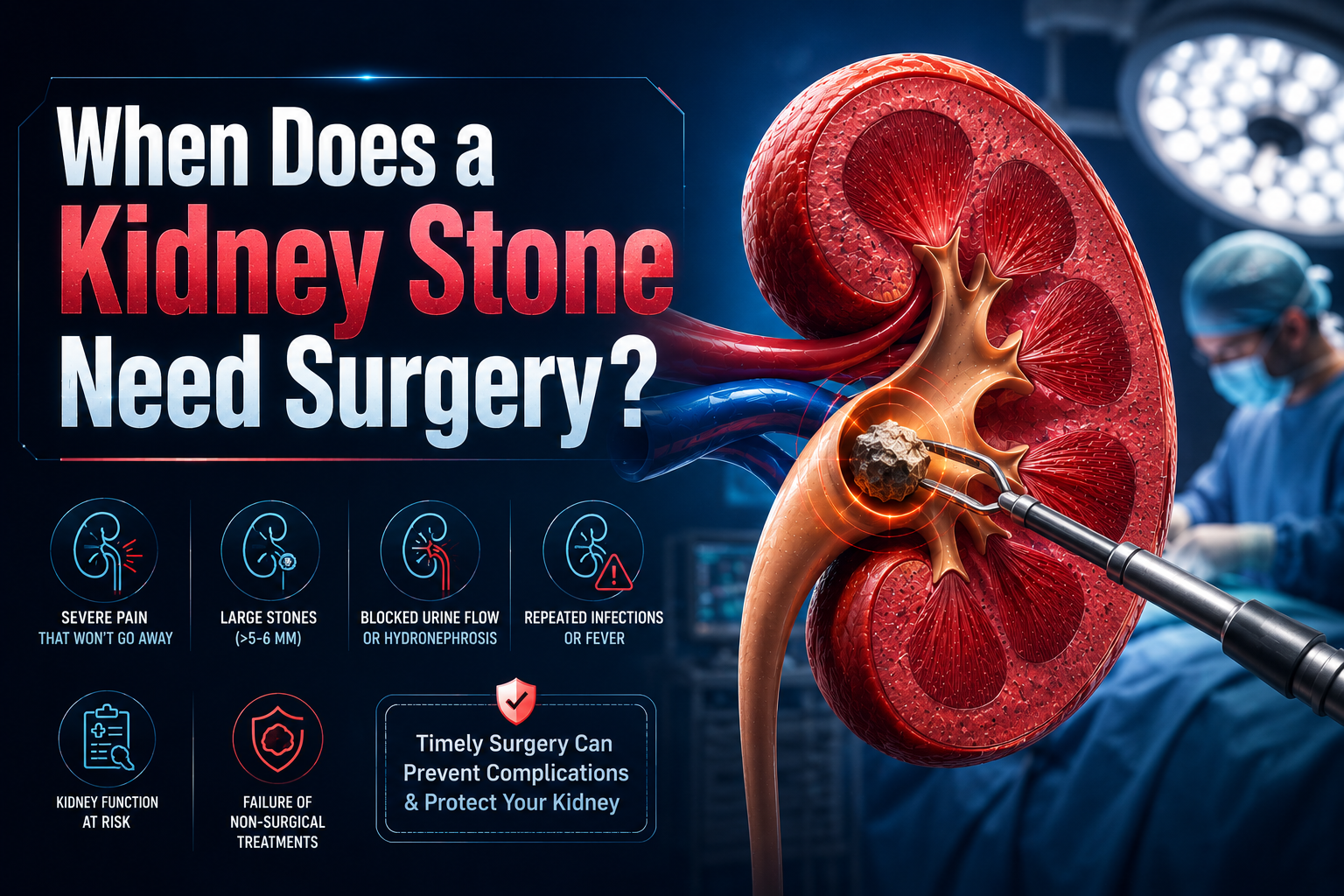
When Does a Kidney Stone Need Surgery?
Being diagnosed with a kidney stone often leads to one important question:
"Will I need surgery?"
The good news is that not every kidney stone requires an operation. Many small stones pass naturally with medication, hydration, and time. However, some stones require intervention to prevent complications and preserve kidney function.
Can Kidney Stones Pass on Their Own?
Yes. Small stones often pass naturally through the urinary tract.
The likelihood of spontaneous passage depends on:
- Stone size
- Stone location
- Degree of obstruction
- Patient symptoms
Generally, smaller stones are more likely to pass without surgery.
👉 Your urologist will determine whether observation is safe in your specific case.
Signs That a Kidney Stone May Need Surgery
1. The Stone Is Too Large
Larger stones are less likely to pass naturally and may remain stuck within the urinary tract.
As stone size increases:
- Passage becomes less likely
- Symptoms may worsen
- Risk of complications increases
2. Persistent Severe Pain
Pain that continues despite medications may indicate ongoing obstruction.
Surgery may be recommended when:
- Pain is severe
- Symptoms repeatedly return
- Daily activities are significantly affected
3. Blockage of Urine Flow
A stone can obstruct the flow of urine from the kidney.
If untreated, prolonged blockage may:
- Cause swelling of the kidney
- Reduce kidney function
- Increase infection risk
⚠️ Protecting kidney function is often a major reason for intervention.
4. Recurrent Urinary Infections
Stones can act as a source of persistent infection.
Repeated infections may lead to:
- Fever
- Kidney damage
- Recurrent antibiotic use
In such cases, stone removal is often necessary.
5. Blood in the Urine
While occasional blood in urine can occur with kidney stones, persistent or recurrent bleeding may require further evaluation and treatment.
6. Declining Kidney Function
If a stone is affecting kidney drainage or causing repeated infections, intervention may be needed to prevent permanent damage.
7. The Stone Is Growing
A small stone detected today may become a larger and more complex stone in the future.
Monitoring helps determine whether:
- The stone remains stable
- It enlarges over time
- Preventive treatment is advisable
What Are the Treatment Options?
Modern kidney stone treatment is highly effective and often minimally invasive.
Depending on the stone's size and location, treatment options may include:
RIRS (Retrograde Intrarenal Surgery)
A flexible telescope is passed through the natural urinary passage to reach and fragment the stone using a laser.
URSL (Ureteroscopic Laser Lithotripsy)
Used for stones located in the ureter.
PCNL (Percutaneous Nephrolithotomy)
Typically recommended for larger kidney stones.
ESWL (Shock Wave Lithotripsy)
Selected stones can be treated using external shock waves.
Your urologist will recommend the most appropriate treatment based on your individual case.
Frequently Asked Questions
Does every kidney stone require surgery?
No. Many small stones pass naturally and only require observation and medication.
Can a painless kidney stone still require treatment?
Yes. Silent stones may still grow, cause obstruction, or affect kidney function.
Is kidney stone surgery painful?
Modern procedures such as RIRS and URSL are minimally invasive and generally involve faster recovery compared with traditional surgery.
When Should You Consult a Urologist?
You should seek urological evaluation if:
- A stone has been identified on imaging
- You have severe or recurrent pain
- You notice blood in urine
- You develop fever or infection
- You have a solitary kidney
- You experience recurrent stone formation
Conclusion
Not every kidney stone requires surgery, but some stones can lead to pain, infection, obstruction, or kidney damage if left untreated. Early evaluation allows your urologist to determine whether observation or intervention is the safest option.
If you have been diagnosed with a kidney stone, a timely consultation can help you understand the best treatment approach for your situation.